
Sewer flow meters for sewage are an essential component of wastewater treatment systems. Different types of flow meters operate on different principles and are suited to varying applications. Selecting the right sewer flow meters for sewage requires careful consideration of factors such as the characteristics of the wastewater and the required measurement accuracy. By efficiently monitoring sewage flow, treatment processes can be optimized, energy consumption reduced, effluent quality improved, and environmental safety ensured—ultimately supporting the sustainable development of wastewater management.
Types of Sewer Flow Meters for Sewage
Sewer flow meters for sewage come in a wide variety of types, each with its own advantages, limitations, and suitable applications. The most commonly used types include electromagnetic flow meters, ultrasonic flow meters, open-channel flow meters, and vortex flow meters.
Electromagnetic Flow Meters
Working Principle:
Based on Faraday’s law of electromagnetic induction, a conductive liquid moving through a magnetic field generates an induced voltage. By measuring this voltage, the flow velocity can be calculated.
Key Advantages:
No moving or intrusive components inside the measuring tube, ensuring minimal obstruction to suspended solids in wastewater and resulting in extremely low pressure loss.
High measurement accuracy and excellent stability.
Unaffected by changes in fluid density, viscosity, or temperature.
Typical Applications:
Municipal wastewater plants: Accurate measurement at key points such as inlet pipes, outlet mains, return sludge lines, and chemical dosing pipelines.
Industrial wastewater: Suitable for flow monitoring of various conductive industrial effluents.
Ultrasonic Flow Meters
Working Principle:
Ultrasonic flow meters calculate flow velocity by measuring the time difference between ultrasonic pulses traveling with and against the flow. They are available in clamp-on types and in-line types.
Key Advantages:
Clamp-on type: Completely non-contact installation, does not interrupt operations, requires no shutdown—ideal for retrofit projects.
In-line type: High accuracy with relatively simple installation.
Typical Applications:
Large-diameter pipelines: Especially suitable for DN300 and above, such as wastewater plant inlet pipes and discharge lines, offering excellent cost performance.
Temporary measurement and verification: Clamp-on ultrasonic meters are portable and are often used for temporary flow monitoring or on-site validation of other flow meters.
Open-Channel Flow Meters
Working Principle:
These systems use specially shaped hydraulic structures—such as Parshall flumes or weirs—installed in open channels. The flow creates a predictable water level difference at a specific point, and the meter calculates flow rate based on the established level–flow relationship.
Key Advantages:
Simple structure with minimal clogging risks, ideal for wastewater containing large amounts of suspended solids.
Lower initial cost and reduced maintenance requirements.
Typical Applications:
Wastewater treatment plants: Widely used for measuring flow in influent channels, effluent channels, and discharge outlets across various treatment stages.
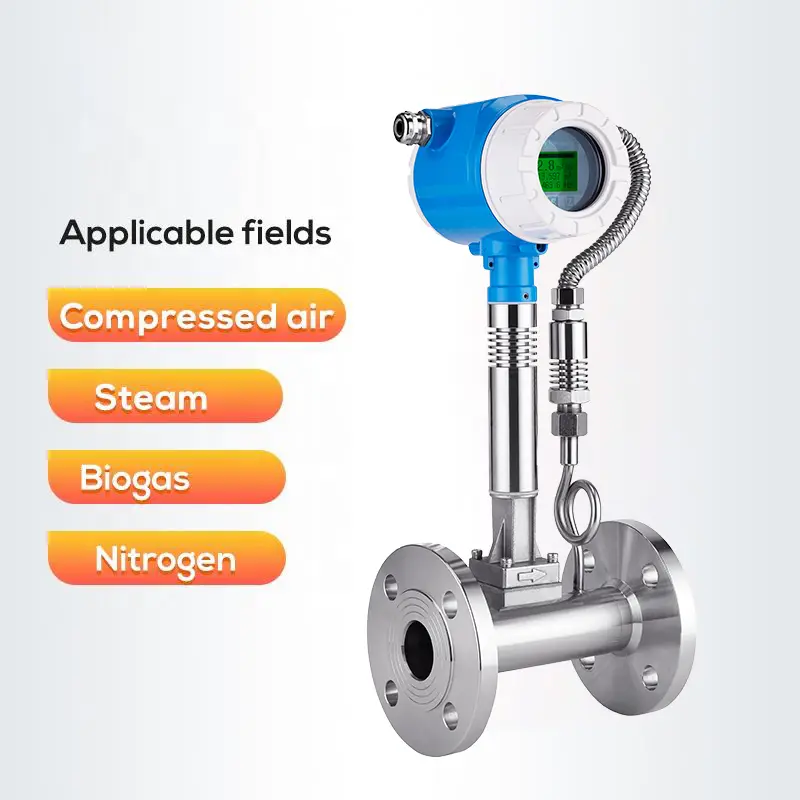
Vortex Flow Meters
Working Principle:
A bluff body (vortex generator) is placed in the fluid stream, generating alternating vortices downstream. The frequency of these vortices is proportional to the flow rate and is measured to determine flow.
Key Advantages:
Robust design with no moving parts, providing high reliability and a wide turndown ratio.
Application Limitations:
Sensitive to vibration.
Not suitable for wastewater containing long fibers or easily entangling materials, as clogging can occur.
Typical Applications:
Primarily used for relatively clean, low-viscosity industrial process wastewater.


Factors to Consider When Selecting a Sewer Flow Meters for Sewage
When selecting a sewer flow meters for sewage, several key factors should be taken into account, including:
- Accuracy Requirements: Determine the level of accuracy needed for your specific application to ensure the chosen meter meets your measurement expectations.
- Flow Range: Consider the expected wastewater flow range to ensure the meter can handle the anticipated volume without issues.
- Environmental Conditions: Evaluate the installation environment—such as temperature, humidity, and the presence of corrosive substances—to choose a meter that can withstand these conditions.
- Installation Requirements: Review installation constraints and system compatibility to ensure the meter can be integrated smoothly with your existing infrastructure.
- Cost and Maintenance: Assess both the initial investment and the long-term maintenance needs to determine the overall cost-effectiveness of the selected meter.
Comparison of Meter Types for Sewage Applications
Each type of flow meter has its own advantages and limitations. Selection should be based on actual process needs:
- Electromagnetic Flow Meters
These offer stable measurement and wide applicability, suitable for a variety of media. However, they can be affected by electromagnetic interference. Their cost also increases significantly with larger pipe diameters. - Ultrasonic Flow Meters
These are relatively low-cost, provide high accuracy, operate stably, and are easy to install and maintain. Unlike electromagnetic meters, their cost does not rise substantially with pipe diameter, though it may increase with the number of ultrasonic paths. - Open-Channel Flow Meters
These have a wide measurement range and are not affected by changes in media properties. However, they are limited by the size and design of the flume or weir. In open-channel systems with sufficient installation conditions and large flow volumes, weir-type and flume-type meters are often used to measure sewage flow.
Benefits of Using an Sewer Flow Meters for Sewage
Using an sewer flow meters for sewage provides numerous advantages for regulatory authorities as well as the wastewater treatment industry. Key benefits include:
- Accurate Monitoring:
Sewer flow meters for sewage deliver real-time, precise flow measurement with minimal error. In the event of an unexpected leak or abnormal discharge, the meter can trigger alerts within seconds, enabling rapid response and reducing potential environmental impact. - Early Problem Detection:
Sewer flow meters for sewage help identify blockages or issues within the wastewater system at an early stage. This allows timely maintenance and prevents equipment failures, system downtime, or overflow incidents. - Process Optimization:
The data collected by an sewer flow meters for sewage can be used to analyze flow patterns and optimize wastewater treatment processes, resulting in improved efficiency and reduced operating costs. - Water Resource Protection:
By continuously monitoring and controlling wastewater flows, sewer flow meters for sewage play a vital role in preventing contamination, protecting natural water resources, and safeguarding ecosystems and public health.
Selecting the right sewer flow meters for sewage requires considering multiple factors. First, the physical properties of the fluid, flow range, temperature, and pressure must be taken into account. Next, the meter’s accuracy, measurement method, and response time should be evaluated. Finally, factors such as reliability, ease of maintenance, and cost must also be considered. When making a choice, it is important to take a comprehensive approach based on the actual requirements.
If you need a highly accurate and reliable sewer flow meters for sewage for your wastewater treatment operations, contact ARTang—a trusted and experienced flow meter manufacturer.

